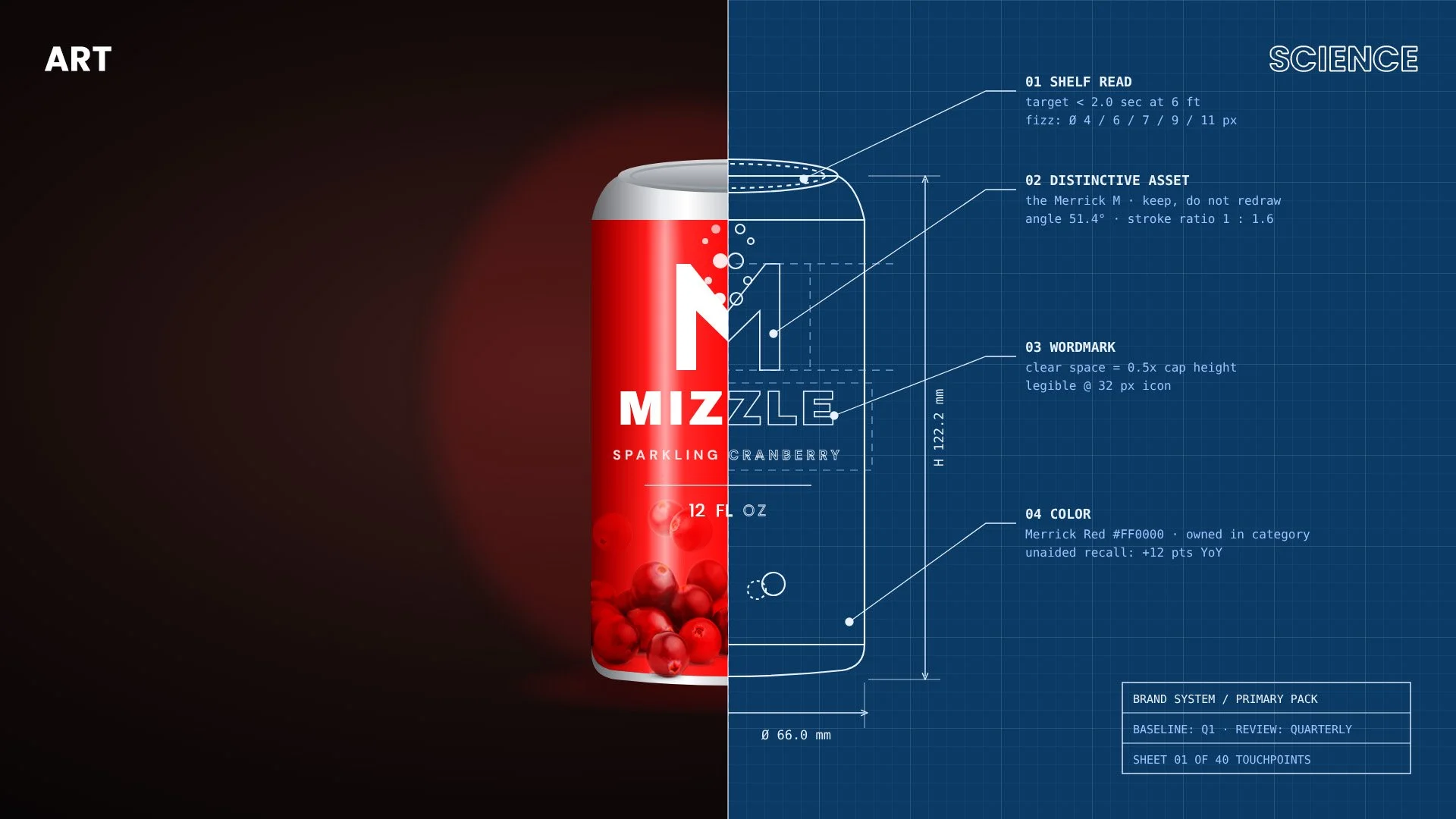
Why the best brand work is half art, half science, and how to tell if your agency speaks both.
Everyone loves the reveal. The logo lands on screen, the room exhales, someone says "chills." It's a great moment. It's also the least important one.
The reveal is day one. A brand lives on day 400. On the shelf at 7:42 a.m. In a thumb scroll. On a construction fence. In a sales deck someone opened without you. The graphics matter enormously. But what decides whether a brand works is everything the graphics are asked to do after the applause stops.
That's where art meets science. And it's the combination, not either one, that you should be hiring for.
Art gets you noticed. Science gets you chosen.
Art is the part you can see: the mark, the palette, the type, the voice, the feeling. Science is the part you can measure: who you're talking to, what they already carry around in their heads, how they actually buy, and whether any of it moved the number.
Art without science is a gamble with a nice font. Science without art is a spreadsheet nobody remembers. The case files prove it.
Exhibit A: Tropicana, 2009
PepsiCo gave Tropicana Pure Premium a clean, modern carton. On paper, a design-forward upgrade. On the shelf, it erased the cues shoppers used to find their juice in two seconds flat: the orange with the straw, the familiar layout. The new box looked like a store brand.
Unit sales of Pure Premium fell 20% between January 1 and February 22. On February 23, Tropicana announced it was bringing the old carton back. The estimated damage ran to tens of millions of dollars.
The lesson: distinctive brand assets aren't decoration. They're memory. Customers don't read packaging. They recognize it. Change the cue without knowing what it's doing, and you've made your best customers work harder to buy you. They won't.
Exhibit B: Mastercard, 2019
Now the flip side. Mastercard wanted to drop its name from its logo and let the interlocking circles stand alone, the way Apple and Nike do. Bold art move. But they didn't start with the art. They started with roughly 20 months of global research.
The finding: more than 80% of people recognized the circles without the word. Only then did the name come off. The same year, Mastercard rolled out a sonic brand so the identity could work in places a logo can't, like checkout chimes and voice.
The lesson: minimalism is earned. Mastercard didn't guess its symbol was strong enough. It proved it, then designed for where the business was going: digital, voice, everywhere.
Exhibit C: Jaguar, still being written
In late 2024, Jaguar unveiled "Copy Nothing": a new wordmark, a new palette, a launch film with no cars in it. The internet had opinions. Lots of them.
The art was unmistakably bold. The science question is timing. Jaguar effectively paused new-car sales in 2025 while it retooled for an all-electric lineup, and the first production model, the Type 01, isn't expected on the road until 2027. That's a brand promise running years ahead of the product that has to keep it.
Maybe it pays off. Repositioning a heritage marque toward a new, wealthier buyer is a legitimate strategy. But the jury stays out until a customer can sit in the thing.
The lesson: a brand is a promise. The experience is the proof. If they show up years apart, the brand carries all the weight alone.
Exhibit D: Airbnb, 2014
When Airbnb launched the Bélo, the reaction was brutal. Memes, mockery, the works. A decade later it's one of the most recognized marks in travel.
Why? Because it was never just a logo. It was a system built around a clear idea, belonging, and it showed up consistently in the app, the listings, the host community and the stay itself. The experience did the convincing that the reveal couldn't.
The lesson: launch-week sentiment is weather. Performance over time is climate. Measure the right one.
What the science actually looks like
"Science" in brand work isn't a lab coat. It's a discipline. Five parts.
Audience truth before pencils. Who buys, why, what they compare you to, and what they'd miss if you vanished. Real research, not a persona with a stock photo.
A distinctive asset audit. What do people already associate with you? A color, a shape, a character, a sound. Know what you own before you change any of it. Tropicana had this answer sitting in plain sight.
A system, not a logo. Pressure-test the identity at every touchpoint: a 32-pixel app icon, a 40-foot banner, a dark-mode screen, a sales deck, a hard hat. If it only works in the brand book, it doesn't work.
Baselines and metrics. Measure before launch so you can measure after. Aided and unaided awareness. Recognition of key assets. Branded search volume. Conversion, lead quality, leasing velocity, sell-through. Sentiment, tracked over months, not hours.
A plan to evolve. Markets move. Audiences age. Platforms appear. Great brands get reviewed on a calendar, with governance that protects the core while the edges flex.
How to evaluate a brand agency
The portfolio tells you they can make it pretty. Good. Necessary. Now ask the harder questions.
Show me the after. Not the reveal video. What happened to the business 6, 12, 24 months later?
What did you learn before you designed? If the answer starts with a mood board, keep asking.
What did you keep, and why? The best agencies are as proud of what they protected as what they changed.
How will we know it's working? If there's no baseline, there's no proof.
Who's in the room? Strategists and designers together, from kickoff. Not a handoff.
What happens in year two? A brand guide is a starting line. Ask who's helping you run the race.
The combination is the point
Pure art agencies give you a moment. Pure strategy shops give you a deck. You need someone who can make people feel something and then prove it moved the business. Someone who knows the logo is the handshake, not the relationship.
That's the work we love at Merrick. The craft that stops the scroll. The rigor that tells you why it did. And the long game that keeps it working long after the reveal.
Pretty gets you a look. Art and science get you a brand.
Ready for your new brand? Let’s talk.