The Night a City Becomes One
Fifty-three years.
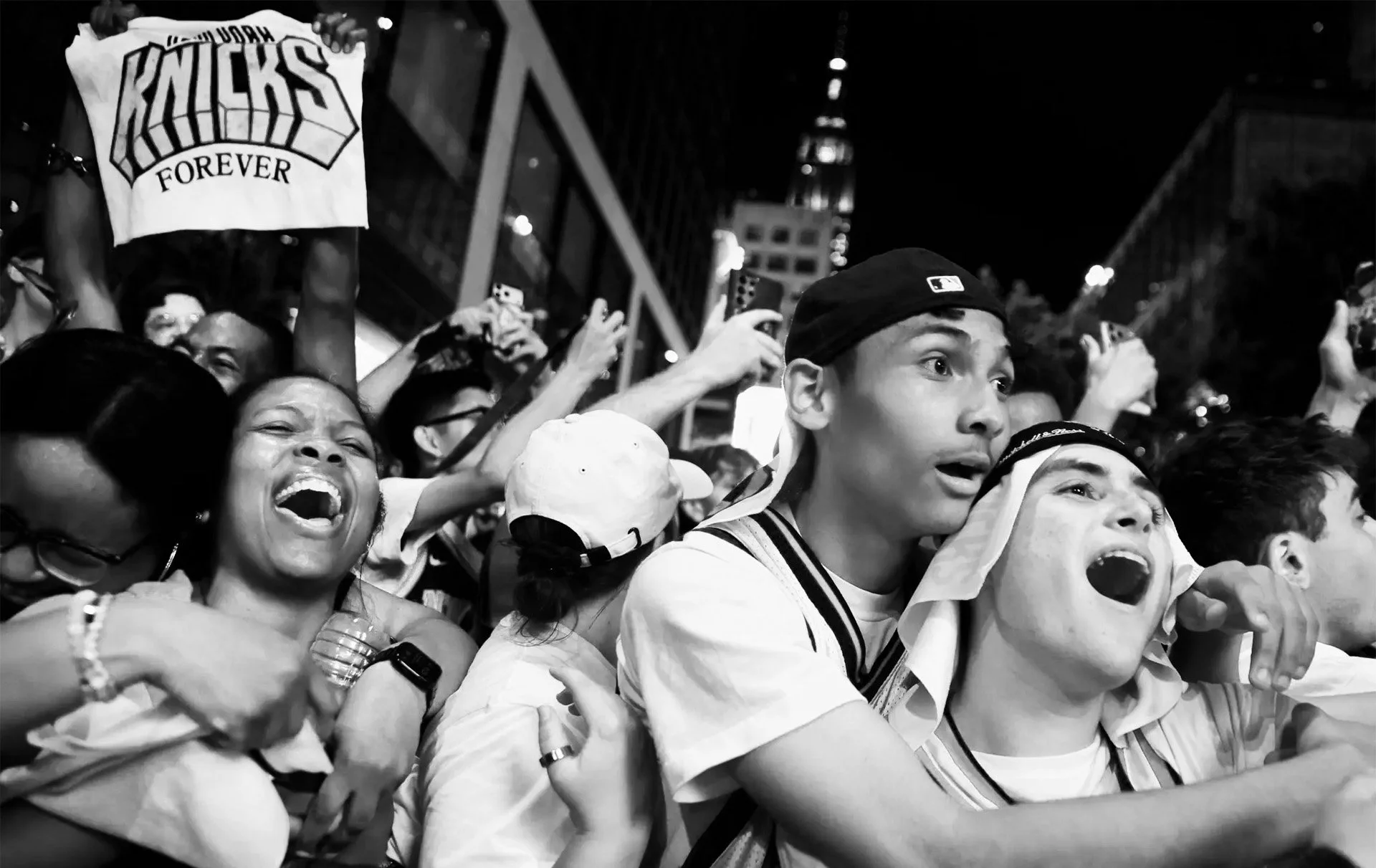
That's how long New York waited. Then Saturday night happened. The Knicks closed out San Antonio in Game 5, took the series 4-1, and somewhere between the final buzzer and the first car horn on Eighth Avenue, eight million strangers stopped being strangers.
You felt it even if you don't care about basketball. The bars emptied onto the sidewalks. People who would not make eye contact on the subway were hugging at the crosswalk. The whole city exhaled at once, like a body that had been holding its breath since the Nixon administration.
There's a name for that feeling. And understanding it is, more or less, our entire job.
The word for it
A French sociologist named Emile Durkheim called it collective effervescence. He was studying religious ritual back in 1912, watching groups gather around something they all believed in, and he noticed the gathering itself produced a kind of energy. A current. People in a crowd, focused on one shared thing, generate a charge that feels bigger than any single person in the room. You walk in as yourself. You walk out as part of something.
He was describing a tribal ceremony. He could have been describing the corner of 33rd and 7th on Saturday.
The feeling is not a metaphor. It's chemistry. When people move together, chant together, jump up at the exact same instant, their bodies sync up. Heart rates align. The brain releases oxytocin and endorphins. Researchers who study synchronized movement have found it does something specific: it makes us trust each other more and cooperate faster. The high-five from a stranger isn't politeness. It's biology doing exactly what it evolved to do.
Why "we" won
Here's the part that should interest anyone who builds brands for a living.
Nobody at that championship watch party scored a single point. They didn't run a play. They didn't coach. And yet ask any of them on Sunday morning and the word they used was "we." We did it. We finally did it.
Psychologists call this BIRGing. Basking in reflected glory. When a group we identify with succeeds, our own sense of self rises with it. The team's win becomes our win. The jersey stops being merchandise and starts being identity. That is why a grown adult will paint their face, scream until they lose their voice, and cry over a game they had no hand in. The boundary between the individual and the group dissolves, and for a few hours, belonging feels like winning.
That's the most powerful force in human behavior. People will not line up for a product. They will line up for a feeling of belonging that a product happens to deliver.
What this has to do with us
Strip away the basketball and you're left with a simple truth. A crowd is not a bigger version of one person. It's a different thing entirely, with its own physics. And the brands that break through are the ones that understand they are not selling to a million individuals. They are trying to spark one shared moment that a million people feel at the same time.
That's the work. Not reach. Resonance.
Most marketing aims at the individual. Right message, right person, right scroll. Fine. Necessary. But the moments that actually move a brand are the ones that turn an audience into a crowd, and a crowd into a "we." A launch that feels like an event. A campaign people quote back to each other. A piece of content that gives a room of strangers permission to feel the same thing in the same beat.
You cannot manufacture fifty-three years of longing. But you can understand the machinery underneath it. The shared focus. The synchrony. The identity that snaps into place when people realize they're not alone in caring about something. Those levers are real, and they're available to any brand willing to aim higher than a click.
A city woke up Saturday night and remembered how to feel together. Our job is to give brands a reason to be the thing a crowd rallies around. Not the vendor in the background. The moment in the middle of the room.
The Knicks gave New York the roar. The rest of us are in the business of building reasons to roar.
And on Saturday, the whole city reminded us why that's worth doing.