What the Derby got right about brand partnership
My wife and I went to the Home Run Derby at Citizens Bank Park (thank you, Tim). Before we left the house Monday I stood in my garage and thought about bringing a glove.
I'm 53. I did not bring the glove.
Hold that garage moment, because it's the whole reason one sponsor did what it did, and one of the two smartest things I've seen a brand do at a live event in a long time.
First, the room
The Derby is supposed to be the last real exhibition in American sports. Nothing at stake. No standings, no replay review, nobody arguing about the strike zone. Eight guys, a batting practice pitcher they hand-picked because he throws it where they like it, and a ballpark full of people who came to watch a baseball get hit into a different zip code.
And that's the appeal, which I don't think gets said plainly enough. It is amazing to watch grown men hit a baseball 450 feet. Boom. Boom. Boom. One after another, into the bleachers, off the facade, into the night. Nothing to root for except distance, and it never gets old, because a ball leaving a bat at 112 miles an hour is one of the genuinely great things a human body can do.
Half the joy is watching where they land. The ball hangs, the section stands up, and forty people go after it like it's the last helicopter out. That's not a break in the action. At a Derby, that's part of the action. The fans in the outfield are on the stage.
Philadelphia, meanwhile, did not get the exhibition memo.
This felt like a playoff game. Every player not wearing Phillies red got booed at introductions. Not polite booing. Real booing, at an exhibition, at guys who flew in to hit batting practice for our entertainment. Willson Contreras figured it out immediately and started egging the crowd on, which only made it worse, which was clearly the point. When he popped up on his last swing in the semis, the place erupted like we'd won the World Series.
That is so Philly it should be in the visitors guide.
It's also the hardest room in sports to put a brand in. No broadcast graphic to hide behind, no halftime, and a crowd that will absolutely turn on you. If your logo shows up in that ballpark it has to earn the space or it just sits there looking like rent.
Two brands earned it. In completely different ways, one of which nearly fell apart in front of everybody.
The gloves
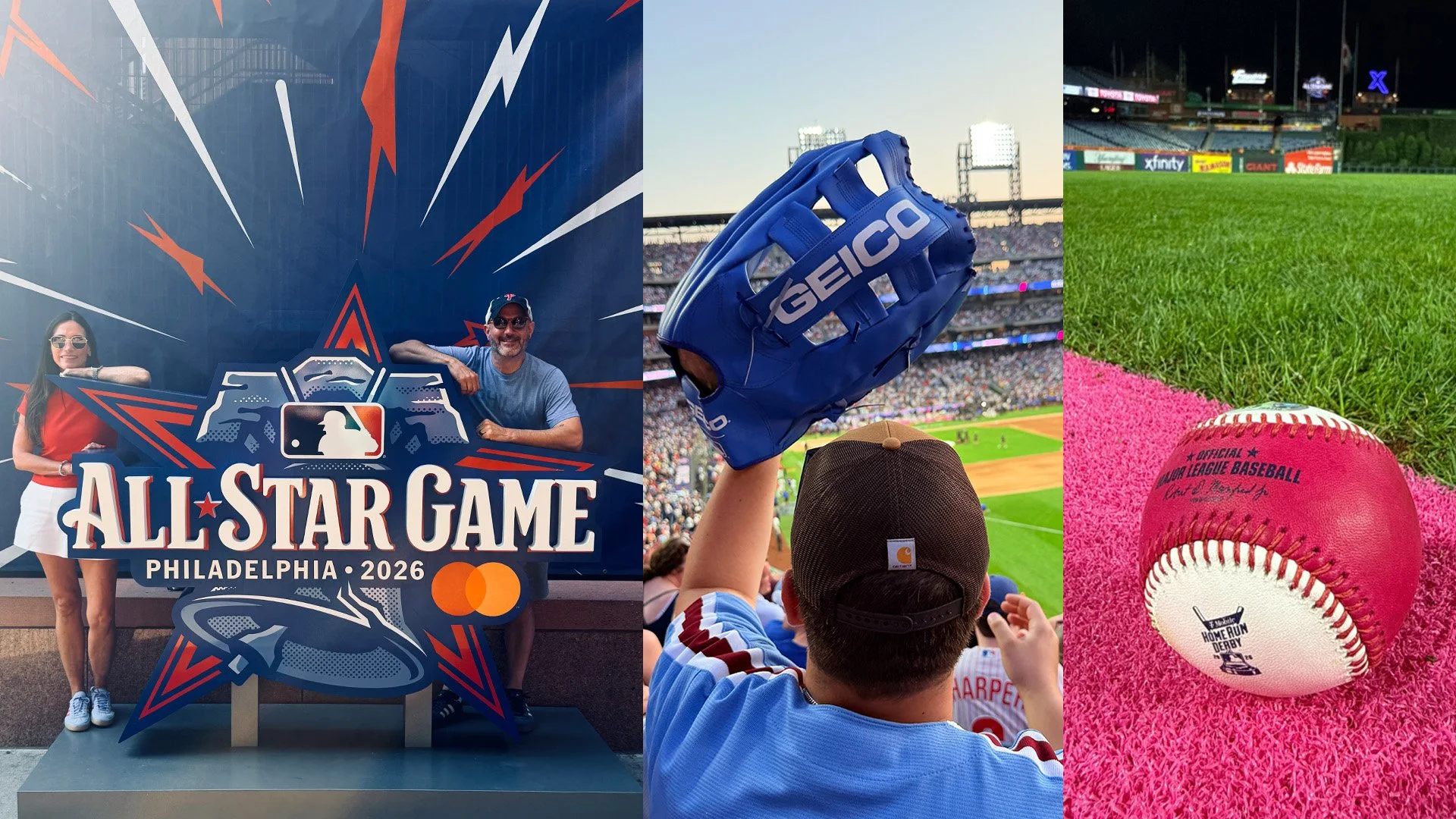
Geico put a giant blue glove on every seat in sixteen outfield sections.
That's the tell right there. Not the concourse. Not a scan-the-code sweepstakes. The sixteen sections where the baseballs actually land. Geico looked at this event, correctly identified the one place where the fans are part of the picture, and dressed it.
Is the glove functional? Not especially. It's enormous and hard to close and I'd bet the house nobody squeezed a 450-foot line drive into one and held on.
Doesn't matter, because catching was never the assignment. For what this event actually is, it's a perfect object. A foot and a half of blue foam that reads from the upper deck and from a center field camera, built for waving and not for fielding, costs nothing, and every person holding one is having a good time. Try designing a better giveaway for a Home Run Derby. I'll wait.
Which brings me back to my garage. Everybody at a Derby has the same fantasy, and it isn't watching a home run, it's catching one. But there's a tax on that fantasy and the tax is looking like a grown man who brought a glove to a ballgame. So most of us leave it home and pretend we didn't want it. Geico removed the tax. When everybody in your section has one, nobody's the guy with the glove. You're not a weirdo, you're in the bit.
And it's a blast to watch. Every ball into the seats sets off a wave of blue, thousands of people on their feet swinging these things around, absolutely losing it. You cannot shoot the outfield without shooting the sponsor, and the sponsor is being worn by delighted people instead of printed on a wall behind them. The goofiness is the most on-brand part, too. Gecko, caveman, hump day camel. A glove that's comically oversized and makes you laugh at yourself is more Geico than a glove that fits.
Anybody who has ever argued over a giveaway line item should sit with that. The question is never what the thing costs. It's whether it lets somebody do what they already wanted to do and couldn't.
The ball
T-Mobile's play was more ambitious and it very nearly ate them.
MLB killed the clock this year. It's swings now, and your last swing of every round comes on the T-Mobile Magenta Ball. Go deep on it, you keep swinging until you make an out.
The sponsor isn't on the outfield wall. The sponsor is a rule. T-Mobile's brand color is the mechanic that decides whether your round is over. That's the ceiling for this kind of thing. You're not renting attention, you're load-bearing.
Then nobody could hit it.
Twelve hitters, two full rounds, zero home runs on it. The Netflix booth kept circling the same theory, that a two-tone ball is harder to pick up out of the hand. Darker on one side, doesn't separate from the batter's eye. Hitters track red stitches against white leather and the magenta was eating the read. Probably true. Probably also something somebody should have tested in a cage in April.
So for two hours the signature element of the broadcast was a dead spot, every round ending on a whiff. If the night ends that way, the magenta ball is a punchline for the next decade and somebody at T-Mobile is quietly updating a resume.
Instead we got the drama.
Everybody in that building not wearing a St. Louis jersey wanted Schwarber. Hometown guy, league leader, the whole night building to it. He gets to his last swing of the final round and hammers the magenta ball 435 feet. Eleven homers. The place is gone.
Then Walker needs four in a row on that same ball to take it from him. Four. Nobody had hit it once all night.
He hit four.
Six home runs on his last six swings, 12 to 11, first Cardinal to ever win the thing, and a sound out of that ballpark I've genuinely never heard before. Not silence exactly. More like the air got let out of the building.
There is no such thing as a walk-off in a Home Run Derby. There was one Monday, and the reason is a pink baseball with a phone company's name on it.
The thing I keep chewing on
I've been trying to decide which is the better piece of work and I don't think I've landed.
Geico's is bulletproof. Costs almost nothing relative to the exposure, delights people, cannot really fail, works again next July. Very good, very repeatable, slightly boring in the way reliable things are boring.
T-Mobile's could have been a disaster, and for most of the night it was one. Most companies would have killed that idea in the room. What if nobody hits it. Fair question, and for two hours the answer was nobody. Then somebody hit it four times and now T-Mobile owns the best ending this event has had in forty years.
That's the part worth taking. The partnerships that actually pay are the ones where you give up control of the outcome. Everything you can fully control is a logo on a backdrop, and nobody has ever looked at a logo on a backdrop.
Both brands understood the same thing from opposite directions. The fan comes first and the brand rides along. One bet on delight, one bet on drama. Neither interrupted the game to get paid.
Great night. Thanks again, Tim. Nice work, Geico and T-Mobile.
And next year, outfield seats.